

SAM MILLER, Managing Editor, South Asia, BBC World Service
“All I say is that you need to play Radio for the long term. This isn't Radio. As you know in the current regime, Radio stations here have to pay huge license fees. From an outsider’s point of view, they don’t have much relationship with potential income. Certainly not in the short term with the kind of Radio market size we have got here. So something has to give. Either these radio stations go out business or just continue to loose huge amount of money or the regulations that surround them change.”



“All I say is that you need to play Radio for the long term. This isn't Radio. As you know in the current regime, Radio stations here have to pay huge license fees. From an outsider’s point of view, they don’t have much relationship with potential income. Certainly not in the short term with the kind of Radio market size we have got here. So something has to give. Either these radio stations go out business or just continue to loose huge amount of money or the regulations that surround them change.”
Sam Miller, Managing Editor, South Asia BBC World Service shares his concerns and observation with Ashish Sinha of exchange4media on the Indian Radio market in general and the emerging private FM Radio market in particular. Q. Let me start by asking you something about the BBC World Service? What makes the BBC World Service click? BBC World service has for many years continued to provide impartial news and information from an international perspective to audiences of about 150 million people around the world. We have got a very long and successful tradition in India and we continue to have very large audiences here. In the past we were heard more and more on the Short Waves around the world. Now you also hear BBC programme on FM stations and on Medium Wave stations around Europe and North America. We also realize that the content is absolutely critical and that we are known by, but it is also critical that we deliver programmes to people in a way that is simple to access. The modern BBC's Strategy is to make sure that we are available in lots of different ways. So in part on Television, on line as well through the internet. But it is also critically important to be available in different ways, which can be short wave, medium wave, FM, Radio through the Internet; it can be through the cable, and World Space that’s available now. So there are lots of different means of delivering radio to the audiences and its important in key markets to be available on number of platforms. That holds the key for BBC.
Q. What is your assessment of the Indian Radio market with the coming of private FM stations? How do you see it evolve in the coming times? What are the challenges in front of the private operators? Well, if we look at it over a long period of time then it has been a very successful radio market, and I would say that there have been significant positive developments in the last few years but there is a serious cause for concern about the radio market. I have traveled a lot around the world and I have traveled a lot in South Asia and I still find it bizarre that you go to Katmandu, a city of merely half a million people, and you have six or seven FM stations, all of them being private. Then you fly for an hour, hour and a half to New Delhi, one of the most important capitals in this region, with about ten million population and only an AIR FM Radio station. But Delhi will see more, which is exciting and an important development, but there will be only three for the city of this size, and it looks like they are likely to be pretty similar to each other so we will not see the kind of differentiation that we see in the other parts of the world. And that’s very important because without differentiation the Indian radio market will not grow. You will reach a situation where all the players will be chasing the larger share of the same market rather than the market growing into other areas.
One area that concerns me is Speech Radio. There is very little of Speech Radio in Indian stations and most of them are busy copying each other. There is a rapid growth in Programming compared to what was there a year ago. The growth in Radio market when you compared to the TV market, is nothing. There remains restriction on news & current affairs, which are hard to justify given the fact that there aren't restriction in current affairs on television. Now when you look around at the neighboring countries like Nepal and Sri Lanka, who have suffered civil wars in recent time, yet Private FM stations continue to broadcast news and current affairs, so I don’t quite understand the argument that says, 'lets restrict news and current affairs' on private FM's. I believe it constraints the growth of private FM in India.
Q. So in other words, there won't be significant growth in private FM station in India without the permission to broadcast news and current affairs? There would definitely be growth, and it will be significant, given how small the radio market is in India. But I don’t think we will see the kind of FM explosion we see in other parts of the world. And the kind of explosion we see on television. Of course entertainment has also been a part of the television growth, but the idea that you can lock off a genre and remove it from the equation without affecting the market, I don’t quite understand that argument. Its important for radio long term that Radio has the ability to compete in very busy media market and at the moment it can compete a bit more because of these FM licenses but not really to the extent, which it could. I worry about the state of radio in the long-term in this country. People in the big city say more often. 'O yes my father used to listen to the radio, my grandfather used to listen to the radio.' The danger at the moment is there is a missing generation for whom Radio has not been a normal part of their life. And the challenge facing the new operators here is to restore that to the heart of the present generation. They can do that to a degree through music, but only to a degree. It is just a part of the overall Radio story.
Q. Which are the geographical areas in India where BBC World Service has the maximum penetration? BBC World Service here is comprised of English, Hindi, Tamil, Bengali, Urdu, and a little bit of Nepali. And by far the largest of those is Hindi. And we know that we get a huge listnership in the Hindi heartland of UP and Bihar. But for Bengali, we have a great following in Bengal and the Northeastern states. Tamil in Tamil Nadu. Urdu is spread pretty much across the north of the country. And we haven’t been able to measure in J&K and the Valley part of Kashmir where we would expect the strongest concentration. So yes, Hindi in the north. English and Tamil in the south. Bengali in the east. Urdu kind of everywhere except in the south and the northeast. BBC as a band in India is huge. People know the BBC in all quarters of this country. And it’s very important that people know actually what our content is. Watching it. Listening to it and accessing it on the Internet. And BBC on its part is serving this nation with news, with education, and with entertainment.
Q. What parallels can you draw from your experience of the private FM market as it prevails in the UK? What can we learn from the UK market? One key fact about the British Radio market is the amount of time spent by an individual on Radio in last one year (compared to the previous thirty years) became more than the average time spent watching the TV. If you look back thirty years in Britain, there were lots of people who where saying that Radio is going to die. TV will have pictures as well as words—they were all wrong. I find some people using that kind of argument here. They don’t realize what role Radio plays. Radio plays an absolute critical role in people's life. It has several advantages over the television, you can carry it around and if a major event happens, all you need is a phone line, you don’t need pictures. The way the British market has developed is exactly like that. The most successful news programme in terms of calling big name guests and in terms of audiences in Britain a Radio programme, called ‘Today’ programme. Radio is what people do more and more in the mornings. Between 7 and 9 in the morning, the Today programme on BBC Radio attracts huge audiences.
Q. Can you share with us some of the programmes of BBC World Service that are doing well in India? On the news front, for instance, there is a programme we are running which has picked up a lot of press coverage as well as significant audience, which is quite simple. It’s a phone-in with a senior government figure. It happens once a week. Its called Hindi Talking Point and it just does that. Its a very old fashioned type of broadcast but it works and you don’t quite get something like that which is topical, obviously you don’t get it on other radio stations. Other things we have done in recent time is that I remember on the 50th anniversary we did something which went around every district of India looking at sort of how the country has progressed. We have done a lot on health and education programming here. One of our drives in recent years has been to get greater sense of what people are thinking than what the politicians or the leaders are thinking. So the ordinary people's voices get heard more. But there are new programme always coming. For example there is a recent programme, which takes a look at the careers. There's no one who is competing directly against us. I long for the day when there is competition in the field of speech Radio from more than the BBC and the All India Radio.
Q. In the past BBC Radio in India commanded huge following. Is it still that popular today? In those days there were not many sources of news. That’s why people came to us. Now there are lots, but we believe we get it right and we believe we are impartial. Those are still things that drive people to us. In this country we have a bigger reporting staff than almost anywhere in the world. We have reporter in every state capital. We train our reporters very well and lots of them have worked in London as well. We have very demanding standards that we expect from them. For me, that’s the key to our success. There is no trick. Its just very good journalism. There is commitment to ensure those standards. We don’t spread rumors. We don’t run stories that people are deliberately putting out. We assess news early on for its importance. Like today's coverage on the budget, which everyone is doing so far, we are a bit more stand back on our part. We would provide perspective. There are lots of good reporters and journalists in the country but sometime I feel that there are not people standing back and looking at the bigger picture, looking at it in world terms. And I still feel that's something, which BBC does very well.
Q. If I ask you for your suggestions on the range of programmes that can be done on these FM stations here, then what will those be? Can private Radio thrive on music alone? I think you can do it in number of different levels. For example, speech based programmes about music. Explaining about music, about the different kinds of music, about the history of music, about people who are popular in music. That is on the simpler level. Then there are the magazines type programmes, which people could do. There are sports programme, which they can do. Consumer affairs programme. I still think that it’s tough for them without news. If you look around the world, most music stations, on the top of the hour have two-three minutes of news. And it’s a sort of driver at that time of the day. It’s not much news, but without it, its like a limb is missing from the Radio. Its heartbreaking.
All I say is that you need to play Radio for the long term. This isn't Radio. Of course it’s pretty tough for the players and they will have to address their advertisers, and may be do some clever marketing. But it will be critical to do good programmes. Programmes to which people will return more often. For that, the choice of presenters will be very crucial. Presenters who connect with their audiences and not just voices who fill the space between the music. Having said that, I believe they will also need really compelling and different content. They are all doing the same thing, with one probably getting 40 per cent, and the others getting the remaining share of the market. So the market will stay relatively static. It won’t grow. Radio has developed the same way in other parts of the world, India is pretty different market from anywhere in the world. So its not completely impossible. But it’s pretty unlikely.
As you know in the current regime Radio stations here have to pay huge license fees. From an outsider’s point of view, they don’t have much relationship with potential income. Certainly not in the short term with the kind of Radio market size we have got here. So something has to give. Either these radio stations go out business or just continue to loose huge amount of money or the regulations that surround them change. I know that the concerned parties are in touch over the issue with the regulators. But this is important in the long term for the policy makers as well as the operators on how to make the Radio industry thrive.
Q. How do you see the association of BBC Radio in the emerging private FM market in India? We can hope to be a key partner to it. We are not like the other major players. We are not seeking to duplicate the kind of things that they are doing. We are seeking partnership. Our interest and their interest in the long term is the continued growth of the Radio market. That’s the critical thing everyone has to keep an eye on rather than 'hey who can get more of a share this week or next week'. Other operators might need this market for commercial reasons, what we are about it to reach out to people with impartial, accurate news and information. Of course we can continue to do that and drive audiences thought the short wave but we recognize that the short wave but we recognize that the short wave in the city is much less appealing than it used to be.
That’s why we are looking at some of the options. We have some of the smaller tie-ups with a few stations in Mumbai. But as I have said before, its very early market here and we are about to see the next phase in Delhi, Kolkata and Chennai. In Mumbai we have an ongoing relationship with RED and GO. RED broadcasts weekly programme, UK Top 20, and with GO we are cooperating on World Cup Cricket coverage. And we are looking out for a longer-term relationship. The one concern is on how this market will grow. We have seen in Mumbai that a lot of programming strategy of the stations changed in a very short time of they being out. I imagine that we will see similar switches in the other markets quite early on. Delhi and Mumbai will see more stations in the time to come. There can be good coverage on issues beyond news and current affairs. There is very little coverage on Drama, Sports, Business, Health and Consumer affairs. There is very little of speech basically at all. I am glad to see that several of the stations have tried but at the moment it’s not like radio to me. Radio means listening genre. Obviously music plays a key role in it. But obviously there is more to it.
Read more news about (internet advertising India, internet advertising, advertising India, digital advertising India, media advertising India)
For more updates, be socially connected with us onInstagram, LinkedIn, Twitter, Facebook Youtube & Whatsapp


TOP STORIES



TRAI releases Consultation Paper on reserve price for auction of FM radio channels
The regulatory body has asked for written comments on the consultation paper from the stakeholders by November 6


The Telecom Regulatory Authority of India (TRAI) has released a Consultation Paper on "Reserve Price for auction of FM Radio channels".
The Ministry of Information and Broadcasting (MIB) sent a reference dated August 22, seeking recommendations of TRAI on reserve prices for 283 cities (260 new + 23 existing) under FM Phase-Ill Policy.
Accordingly, this Consultation Paper has been prepared to seek the comments and views of the stakeholders on issues related to estimation of the reserve prices for auction of FM Radio channels.
As part of the consultative process, the Consultation Paper has been uploaded on the TRAI website.
The regulatory body has asked for written comments on the consultation paper from the stakeholders by November 6. Counter-comments, if any, may be submitted by November 13, the paper said.
Read more news about (internet advertising India, internet advertising, advertising India, digital advertising India, media advertising India)
For more updates, be socially connected with us onInstagram, LinkedIn, Twitter, Facebook Youtube & Whatsapp
 Share
ShareRadio Mango Nerolac ‘Pulikkali’ celebrates the essence of Onam
Radio Mango in association with Nerolac Healthy Home Paints flags off an Onam folklore-themed roadshow in Kerala
Radio Mango in association with Nerolac Healthy Home Paints launched ‘Pulikkali’, an Onam folklore-themed state-wide roadshow that resonates with the ideology of unity among all people, regardless of their caste, colour or religion.
The road show brings to life the most vibrant and eye-catching ritual of Onam, the Pulikkali (Tiger Dance). The campaign also fondly recalls the popular Onam folk song ‘Maveli Naadu Vaneedum Kaalam, Manushar Ellaarum Onnu Poley.’
It is designed around the ancient folklore of the golden reign of King Mahabali when there was no discrimination on the basis of caste or class and there was neither crime, nor corruption.
The dynamic crew of entertainers, dressed as Pulis (Tigers) accompanied by Chenda Melam (traditional percussion) artists will travel across Kerala for 15 days as part of the campaign to emphasise the fact that no matter what, we all are one and whatever the colour, we must unite to make this Onam colourful.
The flag off to the ‘Pulikkali’ roadshow was conducted in Kochi by Malayalam actor Saiju Kurup in the presence of Ravindran Nair, Programme Director, Radio Mango, and Rajesh C., Kerala Regional Sales Manager, Nerolac Healthy Home Paints, at Malayala Manorama’s Panampilly Nagar office.
Read more news about (internet advertising India, internet advertising, advertising India, digital advertising India, media advertising India)
For more updates, be socially connected with us onInstagram, LinkedIn, Twitter, Facebook Youtube & Whatsapp
PM Modi lauds Fever FM’s #PlasticSeBreakUp initiative
In a tweet, the Prime Minister congratulated Fever FM for its innovative campaign to ensure reduced usage of single-use plastic
As part of the Fever Voice of Change CSR initiative, Fever FM launched the ‘#PlasticSeBreakUp’ campaign to make India free from single-use plastic.
Drawing inspiration from Prime Minister Narendra Modi’s message this Independence Day, the initiative urges all shopkeepers to do away with single use plastic bags.
PM Modi too tweeted in support of Fever FM’s Bharat Positive initiative. He said ‘I congratulate Fever FM for their innovative campaign to ensure reduced usage of single use plastic. I urge shopkeepers to take part in this campaign with vigour. Such efforts will add valuable momentum to the Swachh Bharat Mission.’
I congratulate Fever FM for their innovative campaign to ensure reduced usage of single use plastic. I urge shopkeepers to take part in this campaign with vigour. Such efforts will add valuable momentum to the Swachh Bharat Mission! @FeverFMOfficial
— Narendra Modi (@narendramodi) September 12, 2019
Talking about the initiative, Harshad Jain, CEO – Radio and Entertainment, HT Media Ltd and Next Mediaworks Ltd., said, “We are extremely grateful to our honourable Prime Minister for his encouragement and appreciation of our latest Bharat Positive campaign, and assure him of our unending support. This encouragement gives us motivation to continue our work with greater zeal to bring about a positive change in the country. We are committed, with our latest campaign against single use plastic, to drive the citizens towards a plastic free India. Bharat Positive is a Fever Voice of Change (FVOC) initiative, the biggest CSR in the history or radio.”
Gautam Gambhir, cricketer, MP and face of Bharat Positive initiative, said, “Credit to team Fever and the listeners of the radio station. PM sir noticing the campaign is no mean feat, it just gives a shot in the arm. Of course when Mr Modi talks, the world listens. There’s substance in his thoughts and him putting the weight behind ‘Plastic Se Breakup’ campaign will only galvanise the whole movement. The fact that his following cuts across age groups is another huge plus. Through PM’s support, the youth, the mid-aged and the elderly, everyone will know about this campaign.”
Read more news about (internet advertising India, internet advertising, advertising India, digital advertising India, media advertising India)
For more updates, be socially connected with us onInstagram, LinkedIn, Twitter, Facebook Youtube & Whatsapp
RED FM's ‘Pride Ki Side’ campaign highlights LGBTQIA + issues
To celebrate the first anniversary of repealing of Section 377, the initiative will provide a platform to share stories and highlight challenges faced by the community
93.5 RED FM has launched a brand-new initiative – ‘Pride Ki Side’ to celebrate the first anniversary of repealing of Section 377. The initiative will provide a platform to share stories and highlight the various challenges faced by LGBTQIA+. The concept of this campaign majorly aims at educating the masses about the pride community.
RED FM has joined hands with Naz Foundation and Breaking Barriers – a project by students of Tagore International School, Vasant Vihar, Delhi, to sensitise the society at the grass root level.
RED FM is targeting the children at a young age so that they become compassionate and kinder towards LGBTQIA+ children.
To support this belief, various workshops are being conducted in schools to provide a safe and respectful learning environment for everyone. Trained and certified counsellors accompanied by RED FM’s team and RJs are conducting the workshops.
Speaking about this campaign, Nisha Narayanan, COO and Director, RED FM and Magic FM, said, “Looking at the status of LGBTQIA+ community in India, it is high-time we start educating the people about them. Everyone should have the right to openly appreciate and practice who they are and love who they want. At RED FM, we believe in supporting this movement through our humble initiative ‘Pride Ki Side’. We want to raise awareness in the public about the challenges faced by them. We hope more people will come forward, share stories and help empower each other. Our vision is to create an inclusive environment and encourage our audience to adopt a progressive and compassionate outlook towards the LGBTQIA+ community.”
Commenting on the association, Anjali Gopalan, Founder and Executive Director, The Naz Foundation Trust said, “I am so happy that RED FM has taken this step to highlight LGBTQIA + issues. The Naz Foundation (India) Trust is proud to be part of this journey.”
To ensure maximum outreach, RED FM has also introduced a daily special morning show on their radio channel with a counsellor. This engaging and interactive format of the show will address queries and problems of the community who face bullying, hatred and discrimination at institutes or workplace.
Besides this, RED FM has also invited a well-known LGBTQIA+ influencer at their studio who will share stories of courage in dealing with cyber trolls, verbal harassment, and how they moved-ahead and dealt with such situations.
The campaign, which began September 4, runs till September 13.
Read more news about (internet advertising India, internet advertising, advertising India, digital advertising India, media advertising India)
For more updates, be socially connected with us onInstagram, LinkedIn, Twitter, Facebook Youtube & Whatsapp
Dia Mirza supports BIG FM’s green Ganesha initiative
To spread awareness about using eco-friendly Ganesha idols, BIG FM held a two-week-long contest and 15 winners were felicitated with a Tree Ganesha by Mirza
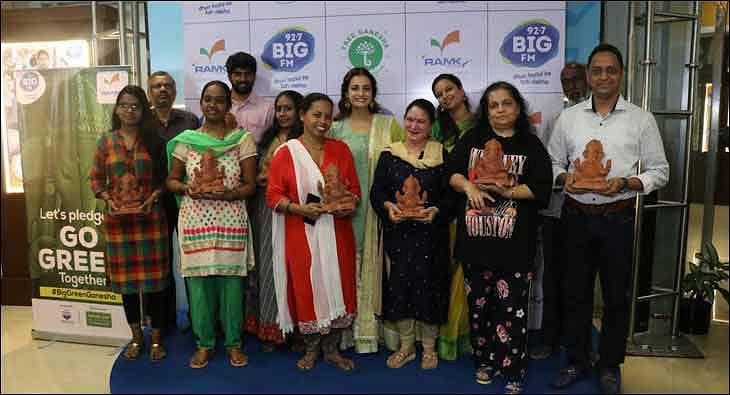
For the 12 th year in a row, BIG FM has brought to light the importance of celebrating festivities in an eco-friendly way through Ramky’s BIG Green Ganesha.
The initiative promotes the use of eco-friendly Ganesha idols and its celebration with minimum environmental damage. RJ Rani, the face of Ramky’s BIG Green Ganesha initiative, hosted the event, which was graced by actress Dia Mirza, Sujiv Nair from Ramky Enviro Engineers Ltd and Ram Kharpuriya, Director - Greenland Farms.
15 lucky contest-winning listeners were felicitated with a Tree Ganesha by Mirza, at the BIG FM office.
To spread awareness about using eco-friendly Ganesh idols, a two-week-long contest was held and it resulted in widespread response from listeners across Mumbai. BIG FM Mumbai associated with Tree Ganesha as they create eco-friendly idols which are made of natural soil and also melts completely after immersion in water bodies as compared to non-biodegradable options that create pollution.
Commenting on the initiative, a BIG FM spokesperson stated, “BIG FM has always tried to bring about a positive change in society. BIG Green Ganesha has been our on-going initiative for the past twelve years which is amplified through on-air and digital channels. We at BIG FM believe in ‘Change starts with you’ and through this campaign tried to raise awareness on the environment pollution created with non-biodegradable idols. The campaign has been very successful till date and we are happy and proud that we as a medium can offer our listeners entertainment with purpose.”
Nair, Chief Human Resources Officer of Ramky Enviro Engineers Ltd, commented, “The Green Ganesha initiative is our contribution to the environment. Being in the space where we closely experience the hazards that affect the environment, we are trying to make Green Ganesha an awareness campaign and save the environment from the use of harmful products. Through this we urge the people to acknowledge an environment-friendly celebration by adopting the use of eco-friendly products.”
Mirza added, “I am very happy to be here. Moreover, I am extremely grateful to BIG FM for this campaign that has been raising awareness over the last 12 years. For the past few years, I have been associating with beach clean ups post the Ganpati Visarjan and it’s very disheartening to see the remains of the idols washed back ashore. Three years ago, Dattadri (Kothur of Tree Ganesha) and I made one of these tree Ganeshas together and it was a beautiful feeling. The happiness you feel while doing something for the better good just elates you to a whole new level. I urge more people to opt for eco friendlier methods, for not just their Ganpati celebrations, but in their day-to-day activities as well.”
Read more news about (internet advertising India, internet advertising, advertising India, digital advertising India, media advertising India)
For more updates, be socially connected with us onInstagram, LinkedIn, Twitter, Facebook Youtube & Whatsapp
Radio Adex: Ad volume sees 8% decrease in indexed growth in Q2 2019
Paytm.com continues to be the top brand to advertise in the services sector in the first half of both 2018 and 2019

The recent Radio Adex report for ad volumes in the medium for the first and second quarter of 2019 shows 8 per cent decrease in indexed growth.
In the first quarter (Jan-March), the service sector had 31 per cent share which came down to 26 per cent in the second quarter (April-June). The retail sector saw increased share in the second quarter. From 8 per cent in the first quarter, the ad volumes from the retail sector increased to 11 per cent. This was the time when IPL, General Elections and World Cup were ruling the roost.
Interestingly, Banking/Finance/Investment sector which was one of the top advertising categories in the first quarter with 12 per cent share, doesn’t find a place in the top five super categories in the second quarter. Education makes an entry in the top five list for Q2 with 10 per cent share. Auto jumped from 8 per cent to 10 per cent, while food beverages declined from 10 per cent to 9 per cent.
If we consider the ad volume in Radio for the first half of 2019 vs the first half of 2018, the indexed growth saw a decline by 9 per cent. Services continue to take the maximum share. In 2018, it was 30 per cent share while in 2019, it is 29 per cent share. Retail, Food & Beverages, Banking, Finance and Investment saw similar shares this year as was in 2018. Auto moved from 8 per cent in 2018 to 9 per cent this year.
Paytm.com continues to be the top brand to advertise in the services sector in the first half of both 2018 and 2019. Google Pay takes the next spot this year as compared to Amazon.in in 2018. Google, Cars24, Yahoo Cricket were the other brands which were a part of the top 5 brands in the first half of 2018. This year, Cars24 remained constant while there has been an addition of Hotstar and Phonepe in the list.
In the retail sector, except for Home Centre (Koz), all the brands that advertised on Radio in the first half of 2018 are missing from the top 5 brands list of 2019. While last year there were Great Eastern Trading, Central (Pantaloons), Max Retail, and South India Shopping Mall, in 2019, they are replaced by Alishan, Reliance Trends, The Chennai Silks and Lifestyle. In the Food and Beverages category, the Pan Masala brands continue to make a mark.
The cars category has jumped from 5 per cent to 7 per cent shares on radio, when compared to the first half of 2018 vs the first half of 2019. Properties/Real Estates have the maximum share of 8 per cent in 2019 compared to 9 per cent in 2018.
Read more news about (internet advertising India, internet advertising, advertising India, digital advertising India, media advertising India)
For more updates, be socially connected with us onInstagram, LinkedIn, Twitter, Facebook Youtube & Whatsapp
FM Tadka goes for makeover with ‘Apni Suno’ campaign
Apart from the new positioning statement, FM Tadka also sports a new logo indicating dialogue within for a positive change

Three months ago, management at the Patrika group decided to go for a makeover of FM Tadka. And just two weeks back, the revamp exercise reached a climax at film studios in Jaipur with RJs all across the country practicing steps for the new jingle video having both an aspirational and inspirational feel to it.
The radio network, spanning six states and 18 cities, started its teaser campaign on August 1 with a mascot named Mr. Mannki who ignited people's minds on the new message hidden in its pose which became quite a hit amongst listeners.
The campaign garnered praise from celebrities across the spectrum. Singers Sukhwinder Singh, Hariharan, Tochi Raina, Aastha Gill, and Hindi film industry stars like Tusshar Kapoor, Mallika Shehrawat, Urvashi Rautela, Sonali Kulkarni, director Nitish Tiwari, Super 30 founder Anand Kumar, comedians Shekhar Suman, Sunil Pal, Raju Shrivastav and sports stars appreciated the concept when it was shared with them during their visits to FM Tadka. The campaign, Apni Suno, talks about making a transformation in life.
“As a country, we have always followed Gandhi ji’s three monkeys, but now the fourth monkey Mr Mannki came with a message- to bring a positive change in your life and to the destiny of the country- Apni Suno. This network philosophy was aptly revealed on Independence Day,” the network said in a statement.
“From students as environment crusaders, young innovators to reality stars from smaller cities- there are many examples of people listening to themselves and carving a new life for themselves. It is this clarion call that FM Tadka is bringing to its listeners and propagating through roadshows, cinema, mall tie ups and artists across the country,” the statement read.
Gaurav S Karrir, the National Programming Head, further reveals, “The prospect of a product change around was quite exciting. We took innovative ways like making Mr Mannki our mascot, mask inserts in newspapers, celeb led Apni Suno life changing stories and using Patrika power in digital, outdoor, print and tv to make people notice the new message of Apni Suno”.
Saurabh Bhandari, National Head Marketing, Patrika Group, who has seen the radio product evolve over the years, applauded team Tadka and shared his vision, saying, “We at Patrika Group always believe to bring change in people’s life. Our endeavour FM Tadka's ‘apni suno’ positioning is yet another step in same direction, there has been a deep study and long research behind this, we are confident listeners and our trade partners will continue their love n support to FM Tadka.”
Apart from a new positioning statement, FM Tadka also sports a new logo indicating dialogue within for a positive change. Shades of blue pointing at freedom of expression. The core TG now is 16-30 with music starting from 2008 and the playlist focused on melody. FM Tadka's flagship Jaipur station now has a new team of RJs making the entire station live with focus on social impact plus technology and sports segments.
Read more news about (internet advertising India, internet advertising, advertising India, digital advertising India, media advertising India)
For more updates, be socially connected with us onInstagram, LinkedIn, Twitter, Facebook Youtube & Whatsapp