

Fragmentation is not all bad
With more and more players venturing in the Indian media, fragmentation seems inevitable, throwing up surplus options for media planners, advertisers and clients. Media professionals put up both sides of the coin - the good and the bad of the issue.



The Indian media brigade is burgeoning everyday. With every new media vehicle venturing in the scene, be it a news channel, a broadsheet or a radio station, the options for media planners, clients and advertiser are increasing and so is the mechanics related with too many options. Doesn't this indicate a Media Fragmentation?
The current exploding media environment has made it possible to reach select TGs through a Kyunki Saas Bhi Kabhi Bahon Thi or a news channel. Even a few years back the advertiser did not have many options. He had a handful of choices at his disposal to reach out to his TG. This has certainly made his job much easier but not necessarily cheaper, as he was reaching out to a bigger set of viewers or readers, which was not a part of his target audience. In other words, spill over was much higher.
Says Anand Halve, Co-founder, Chlorophyll Brand and Communications Consultancy: "There are two sides to the multi-choice media coin. One is media segmentation, which implies partitioning the existing media options, resulting in a value addition. The other and not so good side is media fragmentation. Bad, because it denotes breaking of the existing options without a value addition."
Further elucidating, he adds: "Segmentation helps in reaching my target audience in a very cost-effective way, with the minimum wastage and spill over. Fragmentation is when I spend more than the required money and effort to reach my TG."
It has indeed become easier to focus on a specific set of people in terms of both demographics and psychographics with burgeoning media options. With the variety of options available, consumers can really pick and choose the audience he or she wants to target. The trio at MPG group, Bombay - Sangeeta Dogra - Investment Manager, Shonima Kaul - Planning Manager and Deepak Netram - Planning Director, endorsing Halve's views, echo: "Media fragmentation has created certain niches which when identified make targeting specific audiences much simpler and cheaper, this ensures you don't pay a premium for a spill over audience which you did not want in the first place."
Hiren Pandit, GM, MindShare Mumbai, goes to the extent of calling it a boon. "Fragmentation is definitely a boon as it helps in better targeting of your desired audience. With the available options in hand, you can choose where to invest your advertiser's bucks to get value for money, high visibility and reach."
Fragmentation has changed the media planning process in a big way. While earlier, most planning was done only on the basis of demographics and cost-per-thousand, now various other factors are kept in mind. It is not about rating points and readership now, but about relevant rating points and relevant readership. MPG Bombay group are of the view: "Of the most significant changes fragmentation has brought about, has been the introduction of non-traditional media like Internet, radio and out-of-home sectors into the consideration of media planners. It also causes media planners to think much harder. Had there been no fragmentation, we would not have to work with concepts like intensity of viewing or passive viewing, which have, in turn led us to consider other media."
Reaching out to the male TG is another area where media fragmentation has helped. As MPG Bombay group elucidates, it is possible today to use niche channels like news, English movies, entertainment channels that cater largely to the male audience. These channels will reach the targeted male audience with minimum spillovers and at the same time are cost effective. Prior to fragmentation, the option to go by would be looking at just one mass TV channel.
However, planners do not believe that fragmentation has no flip side. It has indeed made the task of planner far more complicated. And, with so many similar options available, it becomes very difficult to predict where a larger set of relevant TG would be found - more so in the case of mass products. Shedding light on the drawbacks of media fragmentation, Pandit says: "Such a multi-optional scenario proves to be problematic for mass-based brands. They have a tough time in selecting the media vehicles to ride on. To elucidate, a taxi driver and an executive might fall in a SEC-A bracket, but they will have different lifestyles and viewing habits. The taxi driver might choose a Zee Cinema over a Discovery, whereas the English speaking executive will prefer a Star World to a Zee Cinema."
The trio at MPG Bombay, sounds somewhat in line with Pandit. "If we look at the female audience where the stickiness is much higher, fragmentation does not hold much weight. Four years ago when ZEE TV was a clear leader, the viewership was consolidated with the channel but after the spurt of other new general entertainment and Hindi movie genres and with Star Plus steering the leadership in the category, viewership has seen a shift and has consolidated with it," they observe.
In case of mass entertainment, fragmentation has raised the cost of reaching the TG. Commenting on the cost factor, Halve says, "It is heavier on the pocket in the case of fragmentation, such as the serials being aired on Star and Zee between 9 and 11 pm. There being no marked difference in the content, to reach a TRP of 10, an advertiser will have to participate in three serials, resulting in increased costs. Earlier, there were limited options and hence it was cheaper to reach out to a wider audience.
MPG group points out that it is certainly a more expensive proposition compared to the good old years when DD had a monopoly. One spot on a Hindi Feature Film (HFF) or Chitrahaar and your audiences were covered. Yet today, media fragmentation has also brought about greater sophistication to media measurement over the years.
With more options available to the advertiser and increasing day by day, media fragmentation is definitely enriching the lives of all those involved, for better, or for worst.
Read more news about (internet advertising India, internet advertising, advertising India, digital advertising India, media advertising India)
For more updates, be socially connected with us onInstagram, LinkedIn, Twitter, Facebook Youtube & Whatsapp
You May Also Like
TOP STORIES



HT Media posts Consolidated Total Revenue of Rs 580 crore in Q2
Chairperson and Editorial Director Shobhana Bhartia says due to lower commodity prices and control on costs there has been an improvement in operating profit



HT Media has posted a Consolidated Total Revenue for Q2, 2020 at Rs 580 crore.
As per a statement released by the company, EBITDA for Q2’20 increased by 139%, and margins at 14% vis-à-vis 6% in previous year. This has been driven by softening of newsprint prices and continued focus on cost.
The Net Cash position at a consolidated level continues to be strong.
The Print ad revenue has declined due to sluggish volumes, even as yields have improved. National advertising continues to be soft, although local advertising witnessed growth.
Savings in raw material costs have driven improvement in EBITDA margins.
Chairperson and Editorial Director Shobhana Bhartia said, “Slowing economic growth has hit advertising spends in key categories, putting pressure on revenues across the media industry. As a result, our Print and Radio (on like to like basis) businesses saw revenues dip as compared to a year-ago. However, thanks to lower commodity prices and a tight control on costs, we saw an improvement in our operating profit. On the digital front, Shine, our online recruitment portal has shown good progress and continues to grow. Our outlook for the coming quarter remains cautious, given overall economic sentiment and macroeconomic trends. Cost-control and falling commodity prices should help protect our margins.”
Read more news about (internet advertising India, internet advertising, advertising India, digital advertising India, media advertising India)
For more updates, be socially connected with us onInstagram, LinkedIn, Twitter, Facebook Youtube & Whatsapp
 Share
ShareABP Group posts Rs 15.70 crore as net profit in Q1 FY20
The group’s total operating income stands at Rs 365.55 crore
ABP Group has posted a net profit of Rs 15.70 crore in the first quarter of FY20, as per media reports.
The group’s total operating income stands at Rs 365.55 crore.
It’s net profit for the fiscal ended March 31, 2019, was down 68% to Rs 31.90 crore compared to the previous fiscal.
The Profit Before Interest Lease Depreciation and Tax (PBILDT) has also dropped 53.52% to Rs 107.12 crore.
The group has six news channels - ABP News (Hindi), ABP Ananda (Bengali) ABP Majha (Marathi) and ABP Asmita (Gujarati), ABP Sanjha (Punjabi) and ABP Ganga (Hindi).
Read more news about (internet advertising India, internet advertising, advertising India, digital advertising India, media advertising India)
For more updates, be socially connected with us onInstagram, LinkedIn, Twitter, Facebook Youtube & Whatsapp
Zee Media posts consolidated revenue of Rs 137.03 crore for Q2 FY20
ZMCL has recorded 4.4% growth in operating revenue for first half of FY20
Zee Media Corporation Ltd (ZMCL) has posted a 4.4 per cent growth in operating revenue to Rs 337.6 crore in the first half of FY20, as per media reports.
It has reported a consolidated revenue of Rs 137.03 crore for Q2 FY20.
In a statement, ZMCL has said: “During the quarter, the network expanded its footprint s into Southern India through the launch of Zee Hindustan in Tamil and Telugu languages. This is intended to make the network's content accessible to wider audience.”
The operating expenditure in Q2FY20 has dropped by 21.7 per cent.
The statement further said: “EBITDA for HlFY20 improved by 34.1 per cent to Rs 1,029 million from Rs 767.5 million EBITDA for H1FY19, while the same declined by 9.4 per cent to Rs 370.2 million from Rs 408.7 million for the corresponding period last financial year. EBITDA Margin grew from 23.7 per cent in H1FY19 to 30.5 per cent in HlFY20, while growing from 24.2 per cent in Q2FY19 to 27 per cent in Q2FY20.”
Read more news about (internet advertising India, internet advertising, advertising India, digital advertising India, media advertising India)
For more updates, be socially connected with us onInstagram, LinkedIn, Twitter, Facebook Youtube & Whatsapp
No slowdown here: In-cinema ad rates up by at least 50% for 3 big Diwali releases
Housefull 4, Made In China and Saand Ki Aankh ready to hit the silver screen this week, with the hopes of giving brands the eyeballs they look for in theatres

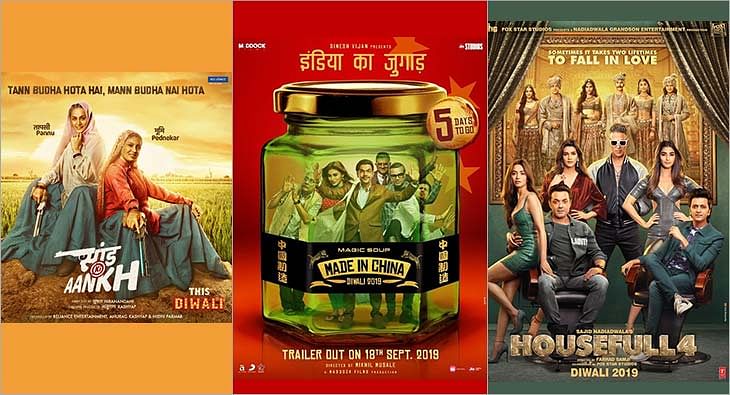
It’s that time of the year again when theatres gear up to pocket maximum gains. Diwali is here and there are three films ready to hit the silver screen this week--Housefull 4, Made In China and Saand Ki Aankh. The festive period brings much joy to exhibitors, distributors and theatre owners because it ensures footfalls, giving brands the eyeballs they look for. In fact, industry experts don’t feel that economic slowdown this year has impacted in-cinema advertising. While they are concerned about three movies clashing during Diwali, they predict 50-100 per cent rise in ad rates during this period.
Advertising moolah
Mohan Umrotkar, CEO, Carnival Cinemas, is expecting 60-70 per cent surge in advertisement topline compared to last year. “Going by the buzz and advance booking for these three releases, market is bullish. Advertisers have blocked most of the advt-slots during the festival period. Housefull 4, Made In China and Saand Ki Aankh all combined together should generate around Rs 350 crore topline at the box office during the festival week. We are expecting 60-70 per cent surge in the advertisement topline from last year. Also, this year we have added around 14 per cent new advertisers, and 4 per cent of them are first-time cinema advertisers,” he says.
But according to Siddharth Bhardwaj, Chief Marketing Officer - Head of Enterprise Sales, UFO Moviez, things have changed a lot in the last couple of years. “Since some films have not really lived up to their expectation, advertisers are spreading the spends all through the year. They are picking up far more number of titles in the year rather than focusing only on Diwali or Eid.”
“It is good for the industry because you can monetise the inventories beyond just big weeks. A lot of content- driven films have come up which has given us the opportunity to monetise more markets. It has put lesser pressure on Diwali. Most of the cinemas are sold out for Diwali. It becomes difficult to accommodate everything,” Bharadwaj opines. He also reveals that for this week, the inventories are already full.
Diwali ad rates
Experts reveal that ad rates differ from property to property and depends on location as well. But Diwali surely sees a massive hike in rates. This year, theatre owners are expecting 100 per cent rise in ad rates. While Umrotkar revealed that for Diwali, they are charging 100 per cent higher than the regular card rates, Girish Johar, trade analyst and film producer, shared that even the rates for putting up kiosks of brands go up during festivals like Diwali.
“It’s based on property. On a ballpark, ad rates double up. So if you are putting up a kiosk, they charge say Rs 50,000-25,000 for a month. During Diwali, they charge almost double because of the kind of footfalls theatres witness,” Johar revealed.
Economic slowdown? Not for Cinema!
This year, brands have been pulling back their spends on other mediums due to economic slowdown, but cinema seems unaffected. Calling entertainment business recession-proof, Johar explains, “If you see the other side, box office is up by 15-20 per cent. Yes, it is a bit subdued because the brands are in a wait-and- watch scenario. They are increasing their focus around consumption rather than awareness.”
Bharadwaj too seconded it by saying, “These are challenging times but our medium is very efficient. If you see economy has slowed down, but the cinema has grown instead.”
Clash cover
Three movies are clashing this Diwali which means shared screens and box office gains.
“It’s never good for us when two or more big-ticket films release together. If they would have come on different dates, there are chances that more advertisers will take advt. inventory in those weeks separately instead of that one particular week,” shares Umrotkar.
Read more news about (internet advertising India, internet advertising, advertising India, digital advertising India, media advertising India)
For more updates, be socially connected with us onInstagram, LinkedIn, Twitter, Facebook Youtube & Whatsapp
INOX Leisure Ltd sees 42% growth in total revenue
Profit After Tax up 327% to Rs 51 crore
INOX Leisure Ltd (INOX) has reported financials for the second quarter ending September 2019.
Its total revenue has risen to Rs 524 crore with a 42% growth from Rs 369 crore in the corresponding quarter in FY19. Its EBITDA has more than doubled to Rs 107 crore with a 121% growth, while the PAT stood at an impressive Rs 51 crore, up 327% from previous year’s second quarter.
Siddharth Jain, Director, INOX Group, said: “At INOX, setting new benchmarks is now a routine, thanks to our consistently sharp focus on luxury, service and technology and our uncompromised desire to offer our patrons, nothing but the latest and the best! We are delighted with our remarkable consistency on all parameters, and we are sure about maintaining the momentum and focus on innovativeness. Content once again proved that why we term it as the ‘hero’. Thanks to the creators of such spellbinding movies, which keep inviting our guests to our properties, and allowing us to pamper them with our signature hospitality. With the launch of Megaplex, we are delighted to further our endeavor of developing experience-driven cinema destinations of global standards, and we will continue to do so. On behalf of Team INOX, I assure all our stakeholders that we will continue to break barriers and exceed all expectations.”
Read more news about (internet advertising India, internet advertising, advertising India, digital advertising India, media advertising India)
For more updates, be socially connected with us onInstagram, LinkedIn, Twitter, Facebook Youtube & Whatsapp
Hathway Cable & Datacom reports 100% subscription collection efficiency in Q2
The broadband subscriber base has increased from the previous quarter’s 840,000 to 860,000
Hathway Cable and Datacom has reported subscription collection efficiency at 100%, and the broadband subscriber base has increased from previous quarter’s 840,000 to 860,000 in quarter ending September, as per media reports.
It has narrowed its consolidated net loss by 74% and the operating EBITDA has been reported 15% up to Rs 107.5 crore compared to Rs 93.1 crore a quarter ago.
The total income has dropped 2%, while the expenditure is down 6%.
In the financial results, the company has said the FTTH markets are leading growth in customer acquisition.
Read more news about (internet advertising India, internet advertising, advertising India, digital advertising India, media advertising India)
For more updates, be socially connected with us onInstagram, LinkedIn, Twitter, Facebook Youtube & Whatsapp
ZEEL posts 7.4% YoY growth in total revenue for Q2 FY20
ZEEL's domestic advertising revenue has grown 1.4% YoY in Q2FY20
Zee Entertainment Enterprises Limited (ZEEL) has reported a consolidated revenue of Rs 2,122 crore for the second quarter of FY20, recording a growth of 7.4% on YoY basis.
The Earnings Before Interest, Tax, Depreciation and Amortization (EBITDA) was recorded as Rs 692.9 crore with an EBITDA margin of 32.7%. PAT for the quarter was Rs 413.2 crore. The Profit After Tax (PAT) for the quarter was Rs 413.2 million, with a growth of 6.9% YoY.
During the second quarter, ZEEL’s consolidated advertising revenue grew by 1.2% YoY to Rs 1,224.7 crore. The domestic advertising revenues grew by 1.4% YoY to Rs 1169 crore.
ZEEL has posted 26.8% YoY growth in Q2FY20 domestic subscription revenue. ZEEL’s consolidated subscription revenue grew by 19.0% to Rs 723.5 crore during the quarter.
ZEEL’s total expenditure in Q2FY20 stood at Rs 1429.1 crore, higher by 9.9% YoY compared to Q2FY19.
While ZEE5 recorded a peak DAU (Daily Active User) base of 8.9 million in September 2019, ZEE5 users watched an average of 120 minutes of content on the platform in the same month.
During Q2 FY20, the television network had an all-India viewership share of 18.4%.
During the quarter, ZEEL’s international business revenue was Rs 208.2 crore. The advertising and subscription revenues for international business declined by 4.0% YoY and 21.5% YoY, respectively.
Zee Music Company has registered 7.1 billion views on YouTube in Q2.
Punit Goenka, Managing Director and CEO, ZEEL, said, “I am pleased with the performance we have exhibited during the quarter. Our entertainment portfolio continues to grow from strength to strength across all formats and maintained its leading position. Our television network has emerged stronger post the implementation of tariff order on the back of a strong customer connect and brand pull of its channels. ZEE5 continued to gain traction across audience segments and markets, driven by its compelling content library and expanding list of partnerships across the digital eco-system. This strong operating performance allowed us to deliver industry leading growth in both advertising and subscription despite the tough macro-economic environment. Domestic subscription growth of 27% has reaffirmed the value proposition our television network has built over the years. The impact of tariff order has now largely settled down and has brought increased transparency along with improved monetization. Our domestic advertising revenue growth, though significantly lower than historical trend, is higher than the industry growth. We have witnessed an improvement in ad spends through the quarter and we believe that the onset of festive season along with measures taken by the government will help revive the consumption growth.”
Read more news about (internet advertising India, internet advertising, advertising India, digital advertising India, media advertising India)
For more updates, be socially connected with us onInstagram, LinkedIn, Twitter, Facebook Youtube & Whatsapp