

Client– agency should team up to face changing environment, say experts
To keep pace with the changing business environment, client and agency should join hands to make a successful advertisement, observe experts at the exchange4media Conclave 2004 in Mumbai.



Changing business realities and new expectations from advertising agencies was the topic in the first session of exchange4media Conclave 2004 at Mumbai. Panelists in this session included the who's who of the advertising and media fraternity. Moderator D Shivkumar, Head Audio Division, Philips, shared the dais with Pranesh Misra, COO, Lowe India, Sam Balsara, Chairman, Madison Communications, Kaushik Roy, Head, Marketing, Reliance Infocomm, Rajesh Jejurikar, Head, Marketing, Mahindra and Mahindra and V Ramani, CEO, South Asia, MPG and CEO, Mediaturf Worldwide.
The adage 'small is beautiful' for ad agencies seemed to be echoed by more than one panelist during the inaugural round of the Conclave.
Referring to the topic, Kaushik Roy, Head, Marketing, Reliance Infocomm, said, "The advertising industry has come a long way from what it was when I joined the industry in 1979. Agencies were operating under mental blocks and indulged in extra activities purely for the sake of the cushion factor. In the face of the evolving business landscape, big is not beautiful, in fact small is better. Certain businesses are meant to be small and advertising is one of them. The moment you become big, you loose your focus. The term small implies to flexibility and creativeness and not the size factor. "
Being an ex-agency hand and currently working for the client, he believed that clients tend to buy good strategies and in order to get real talent, they are willing to pay the right price.
He observed, "Agencies should have a transparent fee structure and also need to desperately reduce operating costs, like doing away with departments such as dispatch." He also spoke about the leaner structure of media agencies vis-à-vis the advertising agencies.
Reiterating Roy's point of view, Sam Balsara, Chairman, Madison Communications, shared, " In the ’90s, agencies were growing at 30 to 50 per cent year on year. The industry began to believe that growth was their birthright and they should have it. What ails the industry today is this addiction to growth and sadly, at any cost. We have grown but at the cost of quality which is not good."
Balsara added that the economy was growing, but the benefit of the same could be noticed only in the telecom and automobile sectors. Sharing some figures that shed light on the status of the advertising industry, he said that as per the AC Nielsen survey, the monolith Rs 470 billion FMCG market, also the mainstay of the advertising industry, had grown by only 1.4 per cent in 2003 and the rural markets for the same plunged by three to four per cent in the same year. Number of seconds on TV time has grown to 200 million seconds. As per Central Statistical Organisation (CSO) figures on expenses like food, beverage and tobacco have fallen from 55 to 49 percent. Expenses on other areas such as housing and communications have also gone up.
He agreed that the media scene had changed rapidly. From broadcasting the industry has moved on to narrow casting. "From talking to the masses we have moved to addressing the audience one on one. The proliferation of media has resulted in combined options by media owners, which in turn is taking away the negotiating power from the agencies," he added.
Pranesh Misra, COO, Lowe India painted the picture of today’s reality. He said, "Time crunch is a big issue these days. From annual reports we have moved up to quarterly reports. More accountability is required in a shorter period. Advertisers do not have the time or patience for long-term brand building. Also, there is an extreme degree of over supply of advertising-related services putting immense pressure on margins and price. "Clients are demanding a greater level of strategising from advertising agencies. They require solutions more than campaigns. All this is putting an extreme pressure on the agencies," he added.
Misra also discussed the loyalty factor that takes a major beating these days. "For client-agency relationship, period has shortened and averages at two to three years. Moreover, brand managers, on an average, work with an agency for 1.2 to two years. And there is immense pressure on them to deliver within that period. This has made short-term returns more important. A campaign is also supposed to deliver within two to three months and if it does not, there is pressure to change it right away," he said.
He ended his insights in the changing business scenario with a question, "Will all this result in quality work from the agencies, especially in a scenario where an agency is as good as its last campaign?"
Ramani, CEO, South Asia, MPG and CEO, Mediaturf Worldwide, believed that more changes had taken place than ever before. Business, communication and consumer - all three have changed. He said, "Smart ideas are needed to drive home the advertiser’s strengths to the consumers and more so the prosumers who are the change drivers. In this age of clutter and media fragmentation, in order to be effective, ads must not only be informative but also entertaining."
Rajesh Jejurikar, Head, Marketing, Mahindra and Mahindra, agreed with the cluttered world scenario for the media industry. "In the current times of low product differentiation and intense competition, rules of the game have changed. New truths should be followed which include rewriting strategy as and when required followed by top-of-the-line execution. If there is a choice to be made between great strategy with average execution and average strategy with great execution, I would opt for the latter."
He also stressed on the point that communications was not just a science but a business of the people as well. It was important to have an acute understanding of social sciences and to address the softer issues of the consumer.
"Research should be considered to seek trends rather than decisions and to seek insights and not solutions. Data should be used for a sharper target group definition. Most importantly, dare to win by being different and following your gut feel," he advocated.
The session moderator D Shivkumar, Head Audio Division, Philips, noted that the booming economy is expected to surge till 2050 and was driving the changing business scenario. Small is indeed beautiful if it reflects flexibility and creativity and it is good to grow but not at any cost. Time crunch was the order of the day and ads needed to be entertaining rather than mere informative. These factors have led to new rules for the advertising game, which should be played like all other games – on gut feel.
After all the panelists had shared their perspectives on the changing business realities for the media industry, Shivkumar put forward a couple of questions to the panel. The first one being, "In the these days of tough times, do clients believe that advertising is the key to growth?"
Balsara answered by saying that in events like the Conclave and other such media get-togethers, clients strongly proposed that they believe in advertising, but when they went back to their offices, they acted differently. This is also one of the primary ailments of the FMCG industry.
Misra added that there were a handful of clients who believed in advertising. They stuck to it even during tough times and got results but sadly this learning does not travel. Jejurikar believed that it was category-specific. He explained his perspective with an example of the automobile industry. He said people buy cars purely because it is a status symbol and such a commodity sells purely on advertising. Commercial commodities on the other hand, such as three wheelers and tempos etc. did not require the assistance of advertising.
Roy held the viewpoint that advertising was the Unique Selling Proposition for any product. In the current times of media clutter and low product differentiation, advertising was the differentiator that consumers fell for.
Ramani said that a decade ago, 35 to 40 per cent of the advertisers were happy with their agencies and as on date, the figures were more or less the same. The only difference being that three to four per cent will openly express their satisfaction while the rest will try and squeeze their agencies still further.
The second question posed before the panel was, "Are clients looking at agencies as just 20-second deliverers or full fledged communications partners?" Misra believed that the 30-second specialist tag for agencies was a dangerous trend. Agencies operating in this genre will shrink the industry. Planning has become a specialist function but it is also crucial to partner the client and understand his problem. Jejurikar said that agencies were communications partners but could not be advertising partners. Each agency had their strength area and no agency was good in all aspects of advertising. Citing an example, he said that Public Relations is one area where agencies were not very strong. And it was an onus on the brand manager to choose the specialist.
Roy held the view that the agencies needed to address all the issues right up till the last layer. Balsara said that TV ads, irrespective of them being 30-second 20-second or 10-second, was the most cost-effective medium to sell a product and he believed there was nothing wrong in putting money in it. Only at times when TV does not work it becomes necessary to consider the other options.
However, it turned out to a very enlightening first session, successful in creating the right mood, of sharing, scrutinising, debating and finally evolving solutions to media-specific issues.
Read more news about (internet advertising India, internet advertising, advertising India, digital advertising India, media advertising India)
For more updates, be socially connected with us onInstagram, LinkedIn, Twitter, Facebook Youtube & Whatsapp
You May Also Like

TOP STORIES



HT Media posts Consolidated Total Revenue of Rs 580 crore in Q2
Chairperson and Editorial Director Shobhana Bhartia says due to lower commodity prices and control on costs there has been an improvement in operating profit



HT Media has posted a Consolidated Total Revenue for Q2, 2020 at Rs 580 crore.
As per a statement released by the company, EBITDA for Q2’20 increased by 139%, and margins at 14% vis-à-vis 6% in previous year. This has been driven by softening of newsprint prices and continued focus on cost.
The Net Cash position at a consolidated level continues to be strong.
The Print ad revenue has declined due to sluggish volumes, even as yields have improved. National advertising continues to be soft, although local advertising witnessed growth.
Savings in raw material costs have driven improvement in EBITDA margins.
Chairperson and Editorial Director Shobhana Bhartia said, “Slowing economic growth has hit advertising spends in key categories, putting pressure on revenues across the media industry. As a result, our Print and Radio (on like to like basis) businesses saw revenues dip as compared to a year-ago. However, thanks to lower commodity prices and a tight control on costs, we saw an improvement in our operating profit. On the digital front, Shine, our online recruitment portal has shown good progress and continues to grow. Our outlook for the coming quarter remains cautious, given overall economic sentiment and macroeconomic trends. Cost-control and falling commodity prices should help protect our margins.”
Read more news about (internet advertising India, internet advertising, advertising India, digital advertising India, media advertising India)
For more updates, be socially connected with us onInstagram, LinkedIn, Twitter, Facebook Youtube & Whatsapp
 Share
ShareABP Group posts Rs 15.70 crore as net profit in Q1 FY20
The group’s total operating income stands at Rs 365.55 crore
ABP Group has posted a net profit of Rs 15.70 crore in the first quarter of FY20, as per media reports.
The group’s total operating income stands at Rs 365.55 crore.
It’s net profit for the fiscal ended March 31, 2019, was down 68% to Rs 31.90 crore compared to the previous fiscal.
The Profit Before Interest Lease Depreciation and Tax (PBILDT) has also dropped 53.52% to Rs 107.12 crore.
The group has six news channels - ABP News (Hindi), ABP Ananda (Bengali) ABP Majha (Marathi) and ABP Asmita (Gujarati), ABP Sanjha (Punjabi) and ABP Ganga (Hindi).
Read more news about (internet advertising India, internet advertising, advertising India, digital advertising India, media advertising India)
For more updates, be socially connected with us onInstagram, LinkedIn, Twitter, Facebook Youtube & Whatsapp
Zee Media posts consolidated revenue of Rs 137.03 crore for Q2 FY20
ZMCL has recorded 4.4% growth in operating revenue for first half of FY20
Zee Media Corporation Ltd (ZMCL) has posted a 4.4 per cent growth in operating revenue to Rs 337.6 crore in the first half of FY20, as per media reports.
It has reported a consolidated revenue of Rs 137.03 crore for Q2 FY20.
In a statement, ZMCL has said: “During the quarter, the network expanded its footprint s into Southern India through the launch of Zee Hindustan in Tamil and Telugu languages. This is intended to make the network's content accessible to wider audience.”
The operating expenditure in Q2FY20 has dropped by 21.7 per cent.
The statement further said: “EBITDA for HlFY20 improved by 34.1 per cent to Rs 1,029 million from Rs 767.5 million EBITDA for H1FY19, while the same declined by 9.4 per cent to Rs 370.2 million from Rs 408.7 million for the corresponding period last financial year. EBITDA Margin grew from 23.7 per cent in H1FY19 to 30.5 per cent in HlFY20, while growing from 24.2 per cent in Q2FY19 to 27 per cent in Q2FY20.”
Read more news about (internet advertising India, internet advertising, advertising India, digital advertising India, media advertising India)
For more updates, be socially connected with us onInstagram, LinkedIn, Twitter, Facebook Youtube & Whatsapp
No slowdown here: In-cinema ad rates up by at least 50% for 3 big Diwali releases
Housefull 4, Made In China and Saand Ki Aankh ready to hit the silver screen this week, with the hopes of giving brands the eyeballs they look for in theatres

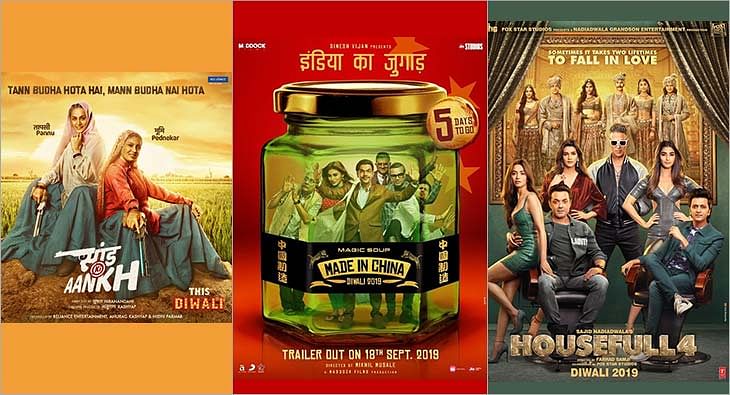
It’s that time of the year again when theatres gear up to pocket maximum gains. Diwali is here and there are three films ready to hit the silver screen this week--Housefull 4, Made In China and Saand Ki Aankh. The festive period brings much joy to exhibitors, distributors and theatre owners because it ensures footfalls, giving brands the eyeballs they look for. In fact, industry experts don’t feel that economic slowdown this year has impacted in-cinema advertising. While they are concerned about three movies clashing during Diwali, they predict 50-100 per cent rise in ad rates during this period.
Advertising moolah
Mohan Umrotkar, CEO, Carnival Cinemas, is expecting 60-70 per cent surge in advertisement topline compared to last year. “Going by the buzz and advance booking for these three releases, market is bullish. Advertisers have blocked most of the advt-slots during the festival period. Housefull 4, Made In China and Saand Ki Aankh all combined together should generate around Rs 350 crore topline at the box office during the festival week. We are expecting 60-70 per cent surge in the advertisement topline from last year. Also, this year we have added around 14 per cent new advertisers, and 4 per cent of them are first-time cinema advertisers,” he says.
But according to Siddharth Bhardwaj, Chief Marketing Officer - Head of Enterprise Sales, UFO Moviez, things have changed a lot in the last couple of years. “Since some films have not really lived up to their expectation, advertisers are spreading the spends all through the year. They are picking up far more number of titles in the year rather than focusing only on Diwali or Eid.”
“It is good for the industry because you can monetise the inventories beyond just big weeks. A lot of content- driven films have come up which has given us the opportunity to monetise more markets. It has put lesser pressure on Diwali. Most of the cinemas are sold out for Diwali. It becomes difficult to accommodate everything,” Bharadwaj opines. He also reveals that for this week, the inventories are already full.
Diwali ad rates
Experts reveal that ad rates differ from property to property and depends on location as well. But Diwali surely sees a massive hike in rates. This year, theatre owners are expecting 100 per cent rise in ad rates. While Umrotkar revealed that for Diwali, they are charging 100 per cent higher than the regular card rates, Girish Johar, trade analyst and film producer, shared that even the rates for putting up kiosks of brands go up during festivals like Diwali.
“It’s based on property. On a ballpark, ad rates double up. So if you are putting up a kiosk, they charge say Rs 50,000-25,000 for a month. During Diwali, they charge almost double because of the kind of footfalls theatres witness,” Johar revealed.
Economic slowdown? Not for Cinema!
This year, brands have been pulling back their spends on other mediums due to economic slowdown, but cinema seems unaffected. Calling entertainment business recession-proof, Johar explains, “If you see the other side, box office is up by 15-20 per cent. Yes, it is a bit subdued because the brands are in a wait-and- watch scenario. They are increasing their focus around consumption rather than awareness.”
Bharadwaj too seconded it by saying, “These are challenging times but our medium is very efficient. If you see economy has slowed down, but the cinema has grown instead.”
Clash cover
Three movies are clashing this Diwali which means shared screens and box office gains.
“It’s never good for us when two or more big-ticket films release together. If they would have come on different dates, there are chances that more advertisers will take advt. inventory in those weeks separately instead of that one particular week,” shares Umrotkar.
Read more news about (internet advertising India, internet advertising, advertising India, digital advertising India, media advertising India)
For more updates, be socially connected with us onInstagram, LinkedIn, Twitter, Facebook Youtube & Whatsapp
INOX Leisure Ltd sees 42% growth in total revenue
Profit After Tax up 327% to Rs 51 crore
INOX Leisure Ltd (INOX) has reported financials for the second quarter ending September 2019.
Its total revenue has risen to Rs 524 crore with a 42% growth from Rs 369 crore in the corresponding quarter in FY19. Its EBITDA has more than doubled to Rs 107 crore with a 121% growth, while the PAT stood at an impressive Rs 51 crore, up 327% from previous year’s second quarter.
Siddharth Jain, Director, INOX Group, said: “At INOX, setting new benchmarks is now a routine, thanks to our consistently sharp focus on luxury, service and technology and our uncompromised desire to offer our patrons, nothing but the latest and the best! We are delighted with our remarkable consistency on all parameters, and we are sure about maintaining the momentum and focus on innovativeness. Content once again proved that why we term it as the ‘hero’. Thanks to the creators of such spellbinding movies, which keep inviting our guests to our properties, and allowing us to pamper them with our signature hospitality. With the launch of Megaplex, we are delighted to further our endeavor of developing experience-driven cinema destinations of global standards, and we will continue to do so. On behalf of Team INOX, I assure all our stakeholders that we will continue to break barriers and exceed all expectations.”
Read more news about (internet advertising India, internet advertising, advertising India, digital advertising India, media advertising India)
For more updates, be socially connected with us onInstagram, LinkedIn, Twitter, Facebook Youtube & Whatsapp
Hathway Cable & Datacom reports 100% subscription collection efficiency in Q2
The broadband subscriber base has increased from the previous quarter’s 840,000 to 860,000
Hathway Cable and Datacom has reported subscription collection efficiency at 100%, and the broadband subscriber base has increased from previous quarter’s 840,000 to 860,000 in quarter ending September, as per media reports.
It has narrowed its consolidated net loss by 74% and the operating EBITDA has been reported 15% up to Rs 107.5 crore compared to Rs 93.1 crore a quarter ago.
The total income has dropped 2%, while the expenditure is down 6%.
In the financial results, the company has said the FTTH markets are leading growth in customer acquisition.
Read more news about (internet advertising India, internet advertising, advertising India, digital advertising India, media advertising India)
For more updates, be socially connected with us onInstagram, LinkedIn, Twitter, Facebook Youtube & Whatsapp
ZEEL posts 7.4% YoY growth in total revenue for Q2 FY20
ZEEL's domestic advertising revenue has grown 1.4% YoY in Q2FY20
Zee Entertainment Enterprises Limited (ZEEL) has reported a consolidated revenue of Rs 2,122 crore for the second quarter of FY20, recording a growth of 7.4% on YoY basis.
The Earnings Before Interest, Tax, Depreciation and Amortization (EBITDA) was recorded as Rs 692.9 crore with an EBITDA margin of 32.7%. PAT for the quarter was Rs 413.2 crore. The Profit After Tax (PAT) for the quarter was Rs 413.2 million, with a growth of 6.9% YoY.
During the second quarter, ZEEL’s consolidated advertising revenue grew by 1.2% YoY to Rs 1,224.7 crore. The domestic advertising revenues grew by 1.4% YoY to Rs 1169 crore.
ZEEL has posted 26.8% YoY growth in Q2FY20 domestic subscription revenue. ZEEL’s consolidated subscription revenue grew by 19.0% to Rs 723.5 crore during the quarter.
ZEEL’s total expenditure in Q2FY20 stood at Rs 1429.1 crore, higher by 9.9% YoY compared to Q2FY19.
While ZEE5 recorded a peak DAU (Daily Active User) base of 8.9 million in September 2019, ZEE5 users watched an average of 120 minutes of content on the platform in the same month.
During Q2 FY20, the television network had an all-India viewership share of 18.4%.
During the quarter, ZEEL’s international business revenue was Rs 208.2 crore. The advertising and subscription revenues for international business declined by 4.0% YoY and 21.5% YoY, respectively.
Zee Music Company has registered 7.1 billion views on YouTube in Q2.
Punit Goenka, Managing Director and CEO, ZEEL, said, “I am pleased with the performance we have exhibited during the quarter. Our entertainment portfolio continues to grow from strength to strength across all formats and maintained its leading position. Our television network has emerged stronger post the implementation of tariff order on the back of a strong customer connect and brand pull of its channels. ZEE5 continued to gain traction across audience segments and markets, driven by its compelling content library and expanding list of partnerships across the digital eco-system. This strong operating performance allowed us to deliver industry leading growth in both advertising and subscription despite the tough macro-economic environment. Domestic subscription growth of 27% has reaffirmed the value proposition our television network has built over the years. The impact of tariff order has now largely settled down and has brought increased transparency along with improved monetization. Our domestic advertising revenue growth, though significantly lower than historical trend, is higher than the industry growth. We have witnessed an improvement in ad spends through the quarter and we believe that the onset of festive season along with measures taken by the government will help revive the consumption growth.”
Read more news about (internet advertising India, internet advertising, advertising India, digital advertising India, media advertising India)
For more updates, be socially connected with us onInstagram, LinkedIn, Twitter, Facebook Youtube & Whatsapp